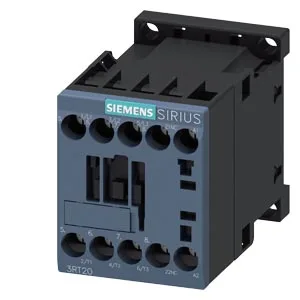
The 24 VDC coil pulls in at 10 A at rated voltage — that's the inrush, not the hold. The auxiliary contacts are rated for switching at various DC voltages: 10 A at 24 V, 2 A at 48 V, 2 A at 60 V, 1 A at 110 V, 0.9 A at 125 V, 0.3 A at 220 V, and 3 A at 400 V. These are DC-13 type loads typically — solenoids, contactor coils, indicator lamps. If you're switching a 24 VDC PLC output to a pilot light, the 10 A rating gives plenty of headroom; at 125 VDC the 0.9 A limit means you can't parallel multiple heavy loads on one auxiliary contact. Switching frequency limits are stated per duty: 1 000 cycles/hour at AC-1 (resistive), 750 cycles/hour at AC-2 and AC-3 (motor starting/running), and 250 cycles/hour at AC-4 (plugging/inching). The AC-3e rating also caps at 750 cycles/hour. For a conveyor motor cycling every 5 seconds, that 750 cycles/hour limit means you can't exceed about one start every 4.8 seconds continuous — stay under it or the contactor overheats. That gives flexibility for tight enclosures, but keep the ambient within the operating range — the coil and contacts derate above 60 °C.
The contactor measures 45 mm wide, 58 mm high, and 73 mm deep — size S00 footprint. It snaps onto a 35 mm DIN rail; clearance requirements: 10 mm upwards, 10 mm forwards, 10 mm downwards, and 6 mm at the side. That's tight — you can pack several contactors side by side on the rail, but leave the 6 mm side gap for airflow and wiring access. Main and auxiliary terminals accept solid or stranded wire: 0.5 to 4 mm² for single conductors, and up to 2x 4 mm² or 2x (0.75 to 2.5 mm²) for two conductors per clamp. Screw-type terminals.