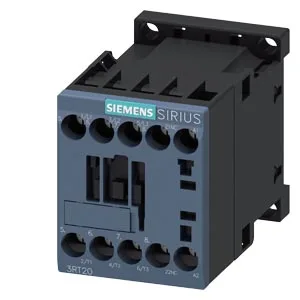
The auxiliary contact set is rated for switching loads across common control voltages: 10 A at 24 V, 2 A at 48 V, 2 A at 60 V, 1 A at 110 V, 0.9 A at 125 V, 0.3 A at 220 V, 3 A at 400 V, and 0.2 A at 440 V.
That 73 mm depth is the dimension to check when the contactor sits behind a gland plate or inside a shallow enclosure — it's the same depth as other S00 frame contactors, so a panel built around a sibling like 3RT2016-1AK22 leaves the same clearance. The solid and stranded wire range is 0.5 to 4 mm², with dual-wire entries for 2x (0.5 to 1.5 mm²), 2x (0.75 to 2.5 mm²), and 2x 4 mm².
Switching frequency and duty cycle
Maximum switching rates depend on the load category: 1,000 cycles/hour for AC-1 resistive loads, 750 cycles/hour for AC-2 and AC-3 motor loads, and 250 cycles/hour for AC-4 (plugging/reversing) duty. For a furnace application where the contactor cycles a resistive heating element, the AC-1 rate is the relevant limit — 1,000 cycles/hour holds the thermal profile without overstressing the contacts.