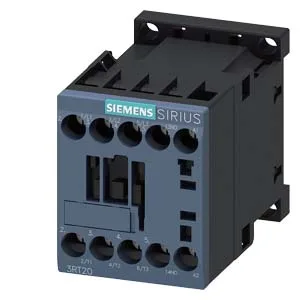
What this SIRIUS S00 contactor brings to a panel
It carries an integrated auxiliary switch and a 24 V DC magnet coil with screw-type terminals, so it slots into a control panel without needing a separate aux block or a special coil connector.
The built-in auxiliary switch is rated for 10 A at 24 V, then derates as voltage climbs: 2 A at 48 V and 60 V, 1 A at 110 V, 0.9 A at 125 V, 0.3 A at 220 V, and 0.2 A at 440 V. At 400 V it still carries 3 A. That curve tells you the switch is designed for 24 VDC PLC or relay logic — at 24 V it handles a solid 10 A inrush, but if you're switching a 220 VAC pilot light or a 440 V contactor coil upstream, the current must stay under 0.3 A or 0.2 A respectively. The 1 hp rating at 230 V is a motor-load reference for small single-phase aux motors.
Switching frequency limits per duty class
The contactor's mechanical life is typical 30 million operations, but the electrical switching frequency depends on the load. At AC-1 (resistive) it can cycle up to 1,000 operations per hour. AC-2 and AC-3 (motor starting, slip-ring and squirrel-cage) allow 750 ops/h, and AC-3e matches that at 750 ops/h. AC-4 (plugging, inching, reversing) drops to 250 ops/h. If your application calls for frequent jogging or reversing, the 250 ops/h ceiling is the binding limit — exceeding it shortens contact life faster than the mechanical count suggests.
Screw-type terminals accept solid or stranded wire from 0.5 mm² up to 4 mm², and dual-wire terminations are supported: 2x (0.5 to 1.5 mm²), 2x (0.75 to 2.5 mm²), or 2x 4 mm². That covers most control-circuit wiring without needing ferrule adapters or ring lugs.