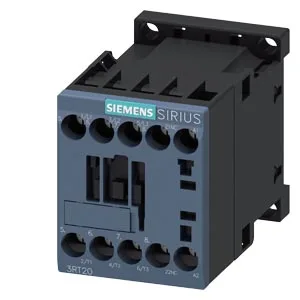
It snaps onto a standard 35 mm DIN rail per EN 60715, and the mounting position allows ±180° rotation on a vertical surface plus ±22.5° tilt forward or back, so you can fit it into tight enclosures without fighting the orientation. At 45 mm wide, 58 mm tall, and 73 mm deep, it tucks into a crowded panel without eating up the whole DIN rail — leaves room for a motor starter or an overload relay next to it.
The coil is screw-type terminals, so you land your control wires with a screwdriver — no push-in or spring-cage on this variant. Switching frequency tells you how hard you can cycle it: AC-1 (resistive loads) up to 1,000 operations per hour, AC-2 and AC-3 (motor starting and running) at 750 ops/h, and AC-4 (plugging or inching) at 250 ops/h (–,). That means for a conveyor motor running a normal start/stop cycle, you get 750 cycles an hour — plenty for most lines; if you're jogging a press, drop to 250 to keep the contacts alive. The auxiliary contact is rated for 10 A at 24 V, 2 A at 48/60 V, 1 A at 110 V, 0.9 A at 125 V, 0.3 A at 220 V, and 3 A at 400 V (–, –,). That covers picking a PLC input or a small relay down the line — watch the voltage drop across long runs at the lower currents. Storage range stretches to -55 to +80 °C — fine for a spare kept in a truck or a warehouse bay. Arcing time runs 10 to 15 ms at AC, and the break time at AC is 4 to 15 ms — fast enough to clear a fault without welding the contacts under normal overload conditions.
No minimums or long lead times flagged on this standard catalog item.
Clearance and wiring notes
Crowd it tighter and you'll shorten the contact life or risk flashover.