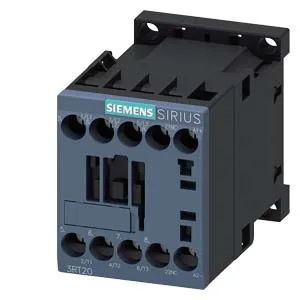
The screw-type coil terminals are what you see here; no spring-cage option on this order code. At 45 mm wide, 58 mm tall, and 73 mm deep, it fits the S00 footprint — tight enough for a crowded DIN rail but still leaves room for wiring.
The contactor's main contacts are rated for 10 A at 24 V, 2 A at 48 V and 60 V, 1 A at 110 V, 0.9 A at 125 V, 0.3 A at 220 V, and 3 A at 400 V. At 230 V it carries a 1 hp motor load — that's the figure you'd use for a small pump or fan. These are the DC-13 / AC-15 auxiliary contact ratings, so they govern the control-circuit switching, not the main power path. The main contact range is listed as 20 to 12, which likely refers to the wire size range for the main power terminals.
Terminals accept solid or stranded wire from 0.5 to 4 mm², and twin-wire terminations are supported: 2x (0.5 to 1.5 mm²), 2x (0.75 to 2.5 mm²), or 2x 4 mm². That covers most control-circuit wiring in a panel — no need for ferrules on solid wire, but stranded should be ferruled for reliable contact under the screw.