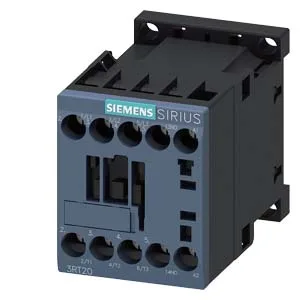
It mounts via screw or snap-on onto a 35 mm DIN rail per DIN EN 60715, with a width of 45 mm and a depth of 117 mm, so it fits the standard S00 footprint without crowding adjacent devices. The contactor carries no built-in auxiliary switch, so you'll need a separate auxiliary contact block if your circuit requires feedback or interlocking. The AC-3 rating of 750 operations per hour tells you the maximum switching frequency under motor starting conditions — enough for a conveyor or pump cycling several times a minute, but not for high-speed jogging. For heavy inrush loads (AC-4), the limit drops to 250 ops/h, which reflects the increased contact wear from plugging or reversing.
Switching capacity and coil draw
The contactor's switching ratings vary by voltage and load type. For motor loads at 230 V, it is rated for 1 hp. The coil holding power is 0.25 W at both 50 Hz and 60 Hz, so the control transformer sees a light continuous draw — useful when multiple contactors are held in on a shared 24 VDC or AC supply. This is within the normal range for a contactor of this size; the snubber or RC network on the load side is not mandatory for most resistive or motor loads, but inductive loads with fast interruption may benefit from a suppressor across the coil.
This means you can orient the contactor to fit tight enclosures or odd panel layouts, as long as the DIN rail is properly supported.