The AC-3 maximum of 750 1/h means it can switch a motor load on and off every 4.8 seconds without exceeding thermal limits; the AC-4 maximum of 250 1/h is the limit for plugging or inching duty, where the contactor makes and breaks stalled rotor current.
Clearance and Mounting Constraints
The arcing time falls between 10 and 15 ms at AC, which means the contactor clears a fault fast enough to coordinate with typical upstream motor-protective breakers.
Wire Termination and Terminal Capacity
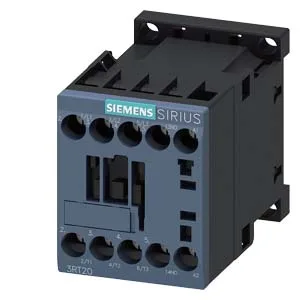
The main circuit terminals accept solid or stranded wire from 0.5 to 4 mm², and can take two conductors per terminal: 2x (0.5 to 1.5 mm²), 2x (0.75 to 2.5 mm²), or 2x 4 mm². This makes daisy-chaining or looping through the contactor straightforward without needing extra terminal blocks. The coil connection uses screw-type terminals — no spring cages here, so a screwdriver and the correct torque are needed for termination.
Rated Operational Currents Across Voltages
The contactor's auxiliary contacts (main contacts used for control) are rated at 6 A at 24 V, 2 A at 48 V and 60 V, 1 A at 110 V, 0.9 A at 125 V, 0.3 A at 220 V, and 0.2 A at 440 V. At 230 V the rating is 1 hp, which is the standard North American horsepower rating for a small motor. At 400 V the rating is 3 A — useful to know if you are switching a control transformer or small three-phase motor directly.
The mechanical life is typically 10 million operations — far beyond the electrical life under load, which is governed by the switching frequency and duty class. No auxiliary switch is integrated into this variant, so any feedback or status indication must come from an external auxiliary contact block.