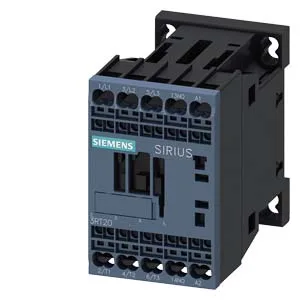
Its 24 VDC coil with spring-type terminals means no screw torque verification during commissioning — strip, insert, release, done. Rated breaking capacity at 24 V is 10 A, which covers small motors, solenoid valves, and lighting contactor duty. At 400 V the rating drops to 3 A, so keep that in mind if you're switching a 400 V motor — the AC-3 motor rating governs the real-world load, not the 24 V number. Switching frequency varies by duty class: 1 000 cycles/hour for AC-1 resistive loads, 750 for AC-2 and AC-3 motor duty, and 250 for AC-4 plugging/reversing. That 250 limit on AC-4 is the one that catches people out on reversing starter applications.
That side clearance is the one to watch when packing multiple contactors side-by-side. Wire range accepts 0.5 to 4 mm² solid or stranded, and 2x (0.5 to 4 mm²) for looping through. Spring terminals mean no re-torquing after thermal cycling — a reliability win for high-vibration environments like conveyor lines.
That covers most indoor panel environments; if your enclosure sees sustained +60 °C ambient, verify the coil hold-in voltage doesn't sag near the dropout threshold.
The 10 A rating at 24 V is the maximum breaking capacity at that voltage — it's not a continuous current rating. For continuous motor current, use the AC-3 rating (not explicitly listed here, but the S00 frame typically handles up to 7 A AC-3). The 3 A at 400 V confirms it's a small-frame contactor, not for main motor switching above about 2.2 kW. Auxiliary switch is included (yes), which saves ordering a separate side-mount block for basic status feedback. The main contact life is rated at 20 to 12 million operations typical — that's the mechanical endurance, not electrical. Electrical life depends on the switching load and frequency; at AC-3 750 cycles/hour, expect significantly fewer.