Spring-type terminals on the coil accept solid or stranded conductors from 0.5 to 4 mm², and up to 2x (0.5 to 4 mm²) per clamp. That covers standard control wiring sizes used in motor starter circuits — no special lugs or ferrules needed, though ferruled stranded wire seats best in the spring cage. The contactor carries switching frequency ratings per duty class: up to 1,000 cycles per hour for AC-1 (resistive loads), 750 cycles/h for AC-2 and AC-3 (slip-ring and squirrel-cage motors), and 250 cycles/h for AC-4 (plugging/reversing). At AC-3e the same 750 cycles/h applies. These numbers govern thermal rise in the enclosure — if your application cycles a motor every 5 seconds, you need to check the AC-3 limit (750/h = one cycle every 4.8 seconds minimum). Auxiliary contacts are present (the contactor includes an auxiliary switch), rated for switching at various voltages: 10 A at 24 V, 3 A at 400 V, and 1 hp at 230 V. That means it can directly switch a small pilot lamp or PLC input at 24 V, or a contactor coil at 400 V, without needing an interposing relay. These are the minimum air gaps to other live parts or grounded metal — critical when laying out the DIN rail to avoid arc flash or tracking between phases. That helps when the contactor sits on a hinged panel door or a slanted sub-panel.
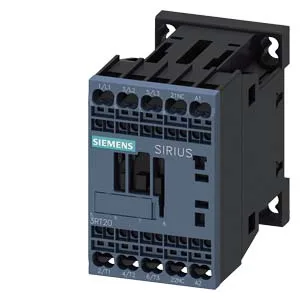
Siemens 3RT2016-2AD02 SIRIUS Power Contactor, Size S00, 24 V
MPN3RT2016-2AD02
Active
Siemens SIRIUS power contactor, 3RT2016-2AD02, Size S00, 24 VDC coil, spring-type terminals, screw and snap-on 35 mm DIN rail mounting.
Source DocumentedChannel stated on listing & quote
Condition PhotosReal unit photos / video on request
WhatsApp AnswersFast human replies for machine-down parts
Worldwide DispatchDHL/FedEx — transit quoted per order
Independent China distributor & sourcing agent· Listing updated Sep 2026
Specifications
| Parameter | Value |
|---|---|
| Contactor frame size | S00 |
| Parameter | Value |
|---|---|
| Rated operational current, AC-12, max. | 10 A |
| Rated operational current, AC-4 @ 400 V | 8.5 A |
| Rated value @ 400 V | 3 A |
| Rated value @ 500 V | 2 A |
| Rated value @ 690 V | 1 A |
| Rated value @ 230 V | 1 hp |
| Rated value @ 24 V | 10 A |
| Rated value @ 60 V | 2 A |
| Rated value @ 110 V | 1 A |
| Rated value @ 220 V | 0.3 A |
| Parameter | Value |
|---|---|
| Control supply voltage type | AC |
| Rated value @ 50 Hz | 0.25 |
| Rated value @ 50 Hz | 42 V |
| Parameter | Value |
|---|---|
| Main poles | 3 |
| Main NO contacts | 3 |
| Auxiliary contact reliability | 1 faulty switching per 100 million (17 V, 1 mA) |
| Parameter | Value |
|---|---|
| Short-circuit coordination type 1, fuse | gG: 35A (690V,100kA), aM: 20A (690V,100kA), BS88: 35A (415V,80kA) |
| Short-circuit coordination type 2, fuse | gG: 20A (690V,100kA), aM: 16A (690V, 100kA), BS88: 20A (415V, 80kA) |
| Aux. switch short-circuit protection, fuse | gG: 10 A (500 V, 1 kA) |
| Parameter | Value |
|---|---|
| Main circuit connection | spring-loaded terminals |
| Aux. / control circuit connection | spring-loaded terminals |
| Conductor cross-section, solid | 0.5 ... 4 mm² |
| Conductor cross-section, solid or stranded | 2x (0,5 ... 4 mm²) |
| Conductor cross-section, finely stranded w/ ferrule | 2x (0.5 ... 2.5 mm²) |
| Mounting method | screw and snap-on mounting onto 35 mm DIN rail according to DIN EN 60715 |
| Side-by-side mounting | Yes |
| Parameter | Value |
|---|---|
| Durability (operating cycles, typ.) | 30 000 000 |
| Durability with aux. switch block (cycles, typ.) | 10 000 000 |
| Parameter | Value |
|---|---|
| Operating temperature range | -25 ... +60 °C |
| Storage temperature range | -55 ... +80 °C |
| Installation altitude, max. | 2 000 m |
| Parameter | Value |
|---|---|
| Width | 45 mm |
| Height | 70 mm |
| Depth | 73 mm |
| Parameter | Value |
|---|---|
| At AC | 4 ... 15 ms |
Product details
Frequently asked questions
What is 3RT2016-2AD02's listed depth?
The depth is 73 mm. This is the dimension from the DIN-rail mounting surface to the front of the contactor body, excluding any protruding terminals or arc chutes.
What conductor cross-section does the spring terminal accept?
Solid or stranded conductors from 0.5 mm² to 4 mm², and up to 2x (0.5 to 4 mm²) per clamp. This covers standard control wiring sizes for motor starter circuits.
MPN
3RT2016-2AD02