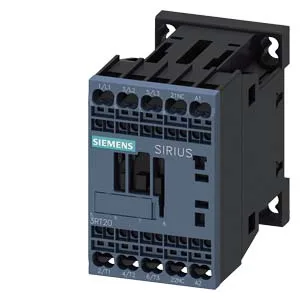
It mounts via screw or snap-on onto 35 mm DIN rail per DIN EN 60715, and the spring-cage terminals accept 0.5 to 4 mm² solid or stranded wire — two conductors per clamp if needed.
The auxiliary contact block (built-in) carries a 10 A rated value at 24 V, dropping to 2 A at 48 V and 60 V, and 0.2 A at 440 V — those numbers govern the signal circuit it can switch, not the main motor path. For motor duty, the contactor is rated at 750 operating cycles per hour under AC-2, AC-3, and AC-3e, and 250 ops/h under AC-4 (plugging/reversing). That tells you it's sized for frequent starting of standard squirrel-cage motors, not for high-inrush or jogging applications. The coil is 24 VDC, and the spring-type terminals mean no screw tightening — strip to 8 mm, push in, done. The contactor measures 45 mm wide by 73 mm deep by 70 mm tall, so it fits a standard 45 mm DIN slot with 6 mm side clearance and 10 mm clearance above, below, and forward.