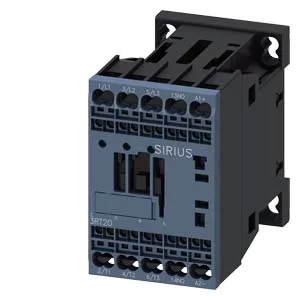
The 3RT2016-2BB41-0CC0: Rated operating voltage is 24 V DC for the coil, with a pickup voltage of 0.8 x rated value and a dropout threshold of 1.1 x rated value, ensuring reliable pull-in and drop-out under nominal conditions. The contactor carries an auxiliary switch (1 N/O + 1 N/C) for feedback or interlocking circuits.
At 45 mm wide, 73 mm deep, and 70 mm high, this S00 frame occupies minimal DIN rail space. These are the minimum air gaps for heat dissipation and arc quenching — a panel OEM wireman should account for them when calculating fill factor and derating.
Switching Capacity and Duty Ratings
Main contact rating at AC-1 (resistive load) reaches 1 000 operations per hour, while AC-3 (motor starting) and AC-3e (enhanced motor) are both rated at 750 ops/h. AC-4 (inching/plugging) drops to 250 ops/h — a field-service tech swapping a failed unit should check whether the application exceeds this frequency, as the contactor will overheat. Switching capacity varies with voltage: 10 A at 24 V DC, 2 A at 48 V and 60 V DC, 1 A at 110 V DC, 0.9 A at 125 V DC, 0.3 A at 220 V DC, and 3 A at 400 V AC. For motor loads, the 230 V AC rating is 1 hp. These figures govern the actual load the contactor can break — not the thermal continuous current.
Wiring and Termination Notes
Spring-type terminals accept solid or stranded conductors from 0.5 mm² to 4 mm², and up to 2x (0.5... 4 mm²) for paralleled feeds. Strip length and ferrule sizing follow standard spring-clamp practice — no screw torque required, but the wire must be fully inserted to engage the cage. These timing windows matter when sequencing multiple contactors in a star-delta or reversing starter — the control logic must account for the dropout delay to avoid shoot-through.
The typical mechanical life of the contactor is 30 million operations, which is the unloaded switching endurance — actual electrical life under load will be lower and depends on the duty cycle and breaking current.