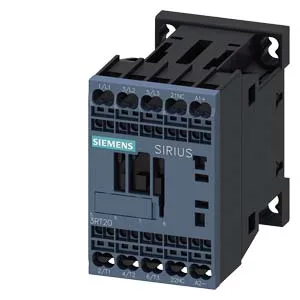
It uses spring-type terminals for the coil and main contacts, accepting solid or stranded wire from 0.5 to 4 mm² (2x 0.5 to 4 mm² for the main contacts).
That's the inrush to pull the armature in; holding current drops to 0.8 A initial value. For a molding cell, that means it holds the zone even near a hot barrel — no derating worry in a typical injection molding hall. Switching frequency limits: 1,000 cycles/hour at AC-1 (resistive loads), 750 cycles/hour at AC-2 and AC-3 (motor loads), and 250 cycles/hour at AC-4 (plugging/inching). The AC-3e rating also caps at 750 cycles/hour. For a conveyor or pump start-stop cycle, you're well within the 750/h limit — but if you're jogging a servo, the AC-4 limit of 250/h is the hard stop. DC switching time (dropout) is 7 to 13 ms. That's fast enough for most safety circuits — the contactor drops out within one mains cycle on a 50 Hz line.
The spring terminals accept solid or stranded wire 0.5 to 4 mm², so you can land 14 AWG to 12 AWG without ferrules, though ferrules are recommended for stranded in high-vibration environments. The +/-180° rotation on vertical surfaces and +/-22.5° tilt flexibility means you can orient the contactor to match the wire entry direction in a crowded cabinet.