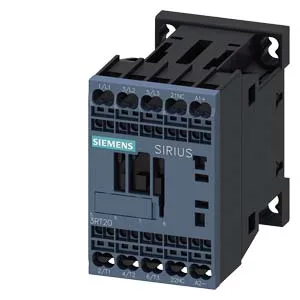
SIRIUS S00 power contactor with 110 VDC coil
The coil holds at 110 VDC nominal and drops out below 0.8 of that voltage. The contactor snaps onto a 35 mm DIN rail per DIN EN 60715, and the mounting position allows ±180° rotation on a vertical surface plus ±22.5° tilt forward and backward — useful when the panel layout forces an off-axis orientation.
DC switching capacity — what the ratings mean
The 3RT2016-2BF42 is rated for DC switching at several voltage points: 10 A at 24 V, 2 A at 48 V and 60 V, 1 A at 110 V, 0.9 A at 125 V, 0.3 A at 220 V, and 3 A at 400 V. These are the maximum currents the main contacts can interrupt at those DC voltages — DC arcs are harder to extinguish than AC, so the rating drops as voltage rises. Operating frequency varies by duty: up to 1 000 cycles per hour at AC-1 (resistive), 750 at AC-2 and AC-3 (motor starting/running), and 250 at AC-4 (plugging/inching). The AC-3e rating also maxes at 750 cycles per hour. These limits govern thermal rise in the contactor — exceeding them shortens life or causes welding.
The contactor measures 45 mm wide, 70 mm high, and 73 mm deep — a compact S00 footprint that fits standard 45 mm-wide DIN-rail slots. No screw torque to check — strip, insert, and the spring holds. An auxiliary switch is built in, so you get one N.O. or N.C. feedback contact without adding a side-mount block — saves a slot on the rail.
The storage range is wider because the contactor is not dissipating heat when stored — that limit governs handling, not running.