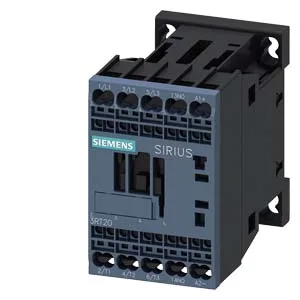
The coil is rated 24 VDC, and the auxiliary contact circuit handles 10 A at 24 V rated value — enough for PLC or relay interface signals. Spring-type terminals accept solid or stranded conductors from 0.5 to 4 mm², so no ferrule crimping is required for solid wire.
The contactor is rated for different switching frequencies depending on duty category: up to 1,000 operations per hour at AC-1 (resistive loads), 750 ops/h at AC-2 and AC-3 (slip-ring and squirrel-cage motors), and 250 ops/h at AC-4 (plugging/inching). The AC-3e rating also caps at 750 ops/h. For a typical conveyor or pump motor running AC-3 duty, this means you can cycle it roughly every 4.8 seconds continuously — but the AC-4 limit is the one to watch if your application requires reversing or jogging. The arcing time is 10 to 15 ms, and the DC switching time (coil drop-out) is 7 to 13 ms, which matters for coordinating with upstream contactors or safety circuits. Operating temperature range is -25 to +60 °C, with storage from -55 to +80 °C. The contactor can be mounted in any orientation within ±180° rotation on a vertical surface, and tilted forward/backward by ±22.5°. Clearance requirements are 10 mm upwards, 10 mm forwards, 10 mm downwards, and 6 mm at the sides — tight enough for dense DIN-rail layouts in a 600 mm wide enclosure.
The Size S00 footprint is 45 mm wide by 70 mm tall by 73 mm deep. Spring-type terminals on both coil and main contacts — strip length for solid wire is about 8-10 mm, no bootlace ferrule needed for stranded if the strands are twisted.