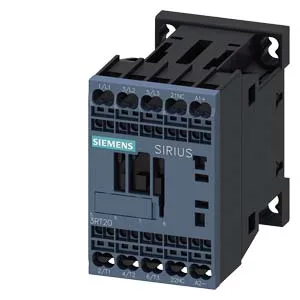
SIRIUS S00 contactor with DC coil
The 3RT2016-2BW42: Its 48 V DC coil with spring-type terminals simplifies wiring and reduces installation time compared to screw-clamp variants. The mechanical life of 30 million operations means it outlasts many panel components in high-cycle service.
Switching frequency and duty class limits
The maximum switching rate varies by duty class: 1 000 cycles/h in AC-1 (resistive), 750 cycles/h in AC-2 and AC-3 (slip-ring and squirrel-cage motors), and 250 cycles/h in AC-4 (plugging/inching). For AC-3e (enhanced motor starting) the limit is also 750 cycles/h. These ceilings set the practical upper bound for process cycle times — exceeding them risks contact welding or premature wear. DC switching ratings are provided for 24 V (10 A), 48 V (2 A), 60 V (2 A), 110 V (1 A), 125 V (0.9 A), 220 V (0.3 A), and 400 V (3 A). The steep derating above 24 V reflects the difficulty of extinguishing a DC arc; for DC motor or brake control, confirm the load current at the applied voltage against these curves. These intervals matter for coordination with upstream fuses or breakers: the arc must clear before the overcurrent device begins to operate.
Mounting and clearance requirements
These ensure adequate airflow and arc-quenching space; crowding the contactor below these distances may cause thermal derating or arc flashover. The compact S00 footprint fits tight panel layouts where space is at a premium.
Lifecycle and sourcing status
The wide storage envelope supports long-term spares holding without degradation.