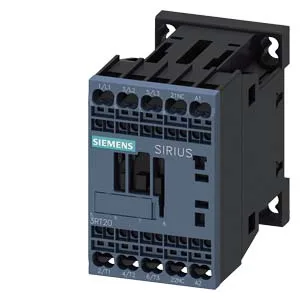
It uses spring-type terminals, so no screwdriver is needed for the power and control wiring — that saves time on the panel build and keeps connections tight under vibration. It snaps onto 35 mm DIN rail per DIN EN 60715, or you can screw-mount it; the mounting position allows ±180° rotation on a vertical surface, plus ±22.5° tilt forward and backward.
DIN-rail fit and clearances
The contactor body is 45 mm wide, 70 mm tall, and 73 mm deep — that's a standard S00 footprint, so it fits in a 45 mm-wide DIN-rail slot. Those clearances matter if you're packing multiple contactors into a small enclosure — the 6 mm side gap is tighter than the vertical ones, so plan your rail layout accordingly.
Spring-type terminals accept solid or stranded wire from 0.5 mm² up to 4 mm², and you can land two conductors of the same cross-section (2x 0.5–4 mm²) per clamp. That's useful for daisy-chaining control power or looping through an auxiliary contact without a separate terminal block. The spring cage holds the wire without retightening — one less thing to check during commissioning.
The contactor is rated for different load categories: AC-1 (resistive) up to 1,000 operations per hour, AC-2 and AC-3 (motor starting) up to 750 ops/h, and AC-4 (inching/plugging) up to 250 ops/h. If you're running a high-cycle application like a conveyor that starts and stops frequently, the AC-4 limit of 250 ops/h is the one to watch — exceeding that wears the contacts faster than the mechanical life suggests.
Environmental range and storage
The power factor at 50 Hz and 60 Hz is 0.9, typical for a contactor coil — nothing unusual there.