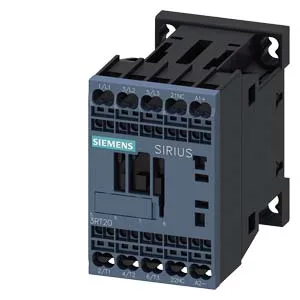
Part identity and core ratings
The Siemens SIRIUS 3RT2016-2KB42 is a coupling contactor in size S00, designed for switching loads in control panels where galvanic isolation or signal-level switching is required — not a power motor starter, but a relay-grade interface between a controller and a higher-current circuit. Provided the contactor is mounted on a 35 mm DIN rail per DIN EN 60715, with the specified clearances — 10 mm upwards and forwards, 6 mm at the sides — the thermal path holds the unit on the grid through the rated operating range of -25 to +60 °C.
The magnet coil terminates via spring-type terminals, which accept solid or stranded conductors from 0.5 to 4 mm², and up to 2x (0.5 to 4 mm²) when doubling up. That spring-cage design eliminates the need for a screwdriver torque check during commissioning — push the ferrule in, it holds. The main contact wiring range follows the same cross-section, so a single wire gauge serves the whole contactor. Strip length is not listed here, but the standard for Siemens spring terminals on this frame is 10 mm; verify against the unit in hand before terminating.
The depth is 73 mm, width 45 mm, height 70 mm — this is a compact S00 frame, so it leaves room for adjacent devices on the same DIN rail, provided you respect those side gaps for heat dissipation.
Switching performance and endurance
Electrical switching frequency depends on the duty category: at AC-1 (resistive loads) the maximum is 1,000 operations per hour; at AC-2 and AC-3 (motor starting, slip-ring motors) it drops to 750 ops/h; at AC-4 (plugging, inching) it is 250 ops/h. For a coupling contactor that sees frequent signal-level switching, the mechanical life is generous; the electrical life at 24 VDC and 10 A will be the limiting factor — derate if switching inductive loads like small solenoids.