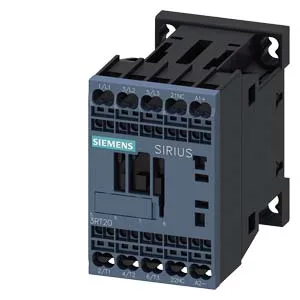
The Siemens 3RT2016-2VB42 is a SIRIUS coupling contactor in Size S00, designed for switching DC loads up to 10 A at 24 V, 2 A at 48 V or 60 V, 1 A at 110 V, 0.9 A at 125 V, 0.3 A at 220 V, and 3 A at 400 V. It is a current-production part, meaning it remains a standard catalog item for new panel builds and critical-spare holding alike. The 24 VDC coil has a rated value of 24 V, a pick-up threshold of 0.85, and a drop-out threshold of 0.85, with an arcing time of 10–15 ms and a DC operating time of 20–80 ms. Spring-type terminals accept solid or stranded wire from 0.5 to 4 mm² (2x 0.5–4 mm² per clamp), which covers most control-circuit wiring gauges without needing ferrules. The contactor mounts via screw or snap-on onto 35 mm DIN rail per DIN EN 60715, and the mounting position allows ±180° rotation on a vertical surface plus ±22.5° tilt forward/backward — useful when fitting into a crowded panel where orientation is constrained.
Switching frequency and duty-cycle limits
Maximum switching frequency depends on the duty class: 1,000 operations per hour at AC-1 (resistive), 750/h at AC-2 and AC-3 (motor starting/running), 750/h at AC-3e (enhanced motor), and 250/h at AC-4 (plugging/reversing/inching). These are the thermal limits of the contactor — exceeding them accelerates wear on the main contacts, which are rated for 20–12 million mechanical operations typical. For a coupling contactor switching DC loads, the AC-3/AC-3e figure of 750/h is a safe upper bound for most interposing applications.
Environmental and installation limits
These clearances matter when packing multiple contactors side-by-side in a panel — the 6 mm side gap is tighter than the vertical ones, so plan your rail layout accordingly.