What it is and where it fits
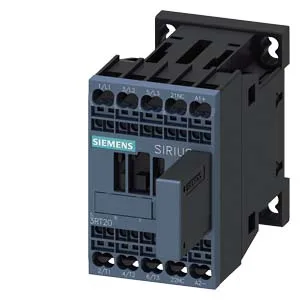
The Siemens 3RT2016-2WB42 is a SIRIUS coupling contactor in Size S00 — the smallest frame in the SIRIUS family, meant for control-circuit isolation or pilot-duty switching rather than main motor loads. It carries a 24 VDC coil with a pick-up threshold of 0.85 × rated (20.4 V) and a drop-out of 0.15 × rated (3.6 V), so it holds cleanly down to about 20 V and releases reliably below 4 V. The contactor snaps onto a 35 mm DIN rail per DIN EN 60715 and can be mounted in any orientation, including rotated 180° on a vertical surface or tilted ±22.5° forward/backward — useful when panel space is tight. The spring-type terminals (cage clamp) accept 0.5 to 4 mm² solid or stranded wire, or two conductors of the same cross-section in one clamp. That saves time on wiring compared to screw terminals, especially in high-density control panels where every second counts.
Key ratings and what they mean for the buyer
The main contact is rated 10 A at 24 V DC — that's the continuous current it can carry in DC control circuits. At higher DC voltages the rating drops: 2 A at 48 V and 60 V, 1 A at 110 V, 0.9 A at 125 V, 0.3 A at 220 V, and 3 A at 400 V. For AC motor duty (AC-3), the maximum operating rate is 750 cycles per hour; for AC-4 (plugging/reversing) it's 250 cycles per hour. The mechanical life is 30 million operations typical, so it's built for high-cycle applications like conveyor interlocks or valve positioners. Arcing time is 10 to 15 ms, and the DC switching time (coil energize to contact closure) is 5 to 20 ms — fast enough for most PLC-driven sequences. The contactor has no built-in auxiliary switch; if you need feedback contacts, you'll add a separate SIRIUS auxiliary block.
Mounting and integration notes
The contactor measures 45 mm wide × 70 mm high × 121 mm deep — the 121 mm depth is the dimension that matters most when fitting into a shallow enclosure or behind a panel door. Clearance distances: 10 mm upward, 10 mm forward, 10 mm downward, and 6 mm to the side. It fastens by screw or snap-on onto a 35 mm DIN rail; the snap-on feature lets you install or remove it without tools, which speeds up panel assembly and future swaps.
