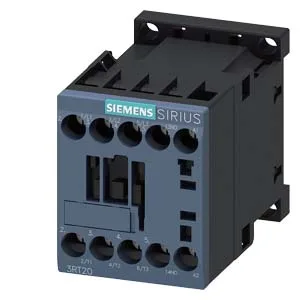
Its 72 V DC coil pulls in at 0.7 of rated voltage (about 50.4 V) and drops out at 1.25 (90 V), with operating times of 25 to 45 ms on DC and an arcing time of 10 to 15 ms. The spring-type terminals accept 2x (0.5 to 1.5 mm²), 2x (0.75 to 2.5 mm²), or 2x 4 mm² solid or stranded wire, and for main contacts 2x (0.5 to 4 mm²) solid or stranded — no ferrules needed, which saves a step on the wire-prep bench.
At 45 mm wide, 70 mm tall, and 73 mm deep, it leaves room for adjacent devices: allow 10 mm upwards, 10 mm forwards, 10 mm downwards, and 6 mm at the side for arc clearance and airflow.
The DC switching ratings tell you exactly what inductive loads this contactor can break: 10 A at 24 V, 2 A at 48 V, 2 A at 60 V, 1 A at 110 V, 0.9 A at 125 V, 0.3 A at 220 V, 3 A at 400 V, 2 A at 500 V, 1 A at 690 V. For AC motor duty at 480 V it carries 7.6 A, and at 600 V it carries 9 A. The 230 V rating is given as 1 hp — a direct motor-starting figure. No auxiliary switch is built in, so if you need feedback to a PLC, plan on a separate auxiliary contact block.