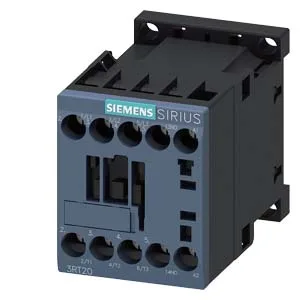
The coil is 24 VDC with screw-type terminals — no special tooling needed for termination. Solid or stranded wire from 0.5 to 4 mm² fits the main and auxiliary contacts, and the terminal accepts dual conductors up to 2x 2.5 mm² or a single 4 mm².
At 230 V it's rated 2 hp, so it can switch a small motor directly if the application allows. Switching frequency matters for high-cycle applications: AC-1 (resistive) allows 1000 ops/h, AC-3 (motor starting) drops to 750 ops/h, and AC-4 (plugging/inching) is limited to 250 ops/h. If you're cycling a conveyor start every 5 seconds, you're at 720 ops/h — fine for AC-3, but AC-4 duty would overheat the contacts. The 60 °C ceiling is typical for inside a sealed panel with no active cooling — if your enclosure hits 65 °C on a summer afternoon, you'll need to derate or add ventilation. For a line running 10 cycles per minute, 16 hours a day, that's about 8.5 years before mechanical wear-out. Contact life under load will be shorter and depends on the switching category.
Clearance and mounting notes
That 6 mm side clearance is tight — you can pack contactors side-by-side on a DIN rail with only a 6 mm gap between them, which saves panel width. That means it works in a panel mounted flat on a wall or tilted on a machine frame — no special orientation required. Operating times: 7 to 13 ms for the main contacts to close, 10 to 15 ms arcing time on break. That's fast enough for most motor control circuits but not for precision timing — if you need <5 ms response, look at a solid-state relay instead.
The SIRIUS 3RT2 family is widely stocked across distribution channels. If you're comparing against the 3RT2026-1AG20 (a larger frame size), note that the 3RT2017 is Size S00 — physically smaller, lower current rating, and different terminal layout. It won't drop into a panel wired for the 3RT2026 without re-termination and possibly a different DIN rail bracket.