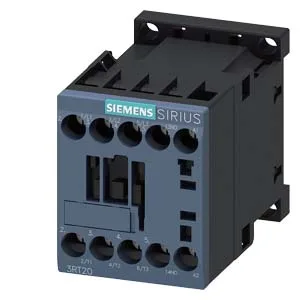
It carries a 24 VDC coil with screw-type terminals and includes an integrated auxiliary switch rated for 10 A at 24 V, 2 A at 48 V, and 0.3 A at 220 V — covering typical PLC and relay interface voltages without an add-on block.
Duty-cycle limits and switching frequency
The contactor's maximum switching frequency depends on the duty class: 1,000 operations per hour for AC-1 resistive loads, 750/h for AC-2 and AC-3 motor starting, and 250/h for AC-4 plugging/reversing. The AC-3e rating also caps at 750/h. These numbers define the thermal limit of the coil and main contacts — exceeding them in a high-cycle application (like a rapid-indexing conveyor) will overheat the magnet system. The practical limit will be electrical wear on the main contacts under load, not the mechanism.
Main and auxiliary terminals accept solid or stranded wire from 0.5 to 4 mm², with the option of two conductors per clamp: 2x (0.5–1.5 mm²), 2x (0.75–2.5 mm²), or 2x 4 mm². The coil terminals are screw-type, so no special crimp tool is needed for the control wiring — a standard PZ1 or PZ2 bit handles it. The auxiliary switch is wired separately from the main poles, with its own terminal set. Arcing time is 10–15 ms at AC, and the opening time at AC is 4–15 ms — fast enough for most safety circuits but not a category-4 instant-off device.
Environmental range and storage
Storage range is wider at -55 to +80 °C — that governs shipping and warehousing, not running conditions.
No end-of-life notice or last-time-buy date is on record.