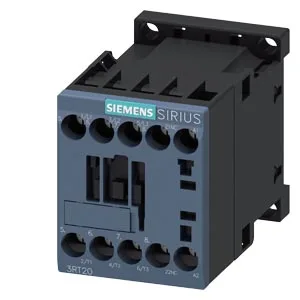
The auxiliary contact is rated for 10 A at 24 V, 2 A at 48 V and 60 V, 1 A at 110 V, 0.9 A at 125 V, 0.3 A at 220 V, and 3 A at 400 V. That covers most PLC-level and relay interface voltages — the 24 V rating is the one you'll use most often in a standard control panel. The motor rating at 230 V is 2 hp, so it's sized for smaller three-phase motors like those on pumps or small conveyors. Switching frequency limits: 1 000 cycles/hour at AC-1 (resistive), 750 cycles/hour at AC-2 and AC-3 (motor starting/running), and 250 cycles/hour at AC-4 (plugging/inching). If your application involves frequent jogging or reversing, the AC-4 ceiling is the one that governs — don't spec it for a high-cycle inching station without accounting for that derating. Mechanical service life is 30 000 000 operations typical, which is high for a contactor this size — it reflects the SIRIUS design's durability in cyclic duty.
Wiring and Clearance Notes
Main contacts accept solid or stranded wire from 0.5 to 4 mm², and the screw terminals can take two conductors per clamp: 2x (0.5–1.5 mm²), 2x (0.75–2.5 mm²), or 2x 4 mm². That's enough for most motor circuit branch wiring up to the contactor's rating. These aren't just suggestions — they're needed for arc dissipation and heat rise. In a dense panel, the 10 mm vertical clearance is often the tightest constraint.