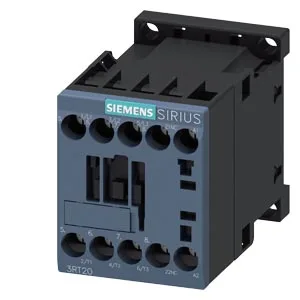
The 24 VDC coil is terminated with screw-type terminals, a conventional choice that suits maintenance teams familiar with screwdriver terminations. The auxiliary contacts are rated for switching at various voltages: 10 A at 24 V, 2 A at 48 V and 60 V, 1 A at 110 V, 0.9 A at 125 V, 0.3 A at 220 V, and 3 A at 400 V. These ratings define the maximum switching capability for pilot duty and signal-level loads; for example, the 10 A at 24 V covers most PLC digital outputs and relay coils in a 24 VDC control circuit. The contactor is rated for maximum operating cycles per hour by duty class: 1,000 cycles/h at AC-1 (resistive), 750 cycles/h at AC-2 and AC-3 (motor starting and running), and 250 cycles/h at AC-4 (plugging and inching). This means for a conveyor motor running under AC-3 duty, the contactor can be cycled up to 750 times per hour without exceeding thermal limits. The mechanical life is typical 30 million operations, indicating the contactor is built for high-cycle applications like packaging or material handling.
The main and auxiliary terminals accept solid or stranded wire from 0.5 to 4 mm², with dual-wire capacity: 2×(0.5…1.5 mm²), 2×(0.75…2.5 mm²), or 2×4 mm². This covers common control wiring sizes in North American (AWG 20–12) and European (0.5–4 mm²) practice. The screw-type terminals on the coil are the same style, so one screwdriver handles all terminations on the device.