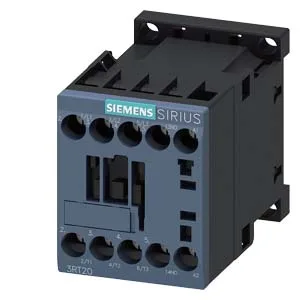
It carries a 24 VDC coil with screw-type terminals, and includes an integrated auxiliary switch.
The contactor is rated for AC-3 switching at up to 750 operations per hour, and AC-4 at 250 operations per hour. The AC-3e rating matches the same 750 cycles/hour — that's the duty cycle for standard motor starting, so it handles frequent starts on pumps or conveyors without overheating the coil or contacts. Auxiliary contact ratings are given for DC switching: 10 A at 24 V, 2 A at 48 V or 60 V, 1 A at 110 V, 0.9 A at 125 V, 0.3 A at 220 V, and 0.2 A at 440 V. These are the contact current limits for the built-in auxiliary switch — useful when driving PLC inputs or relay coils in the same panel. Wire capacity accepts solid or stranded conductors from 0.5 to 4 mm², and can take two conductors per clamp: 2x 0.5–1.5 mm², 2x 0.75–2.5 mm², or 2x 4 mm². That covers most control wiring without needing ferrules, though stranded with ferrules is cleaner for maintenance.
Clearance and integration notes
The contactor measures 58 mm high, 45 mm wide, and 73 mm deep. That's tight enough for most 600 mm deep enclosures, but watch the forward clearance if the door has a handle or interlock. The arcing time on the main contacts is 10–15 ms at AC, and the coil pickup time is 4–15 ms. That's fast enough for most safety circuits, but verify the total break time if you're coordinating with a fuse or breaker upstream.