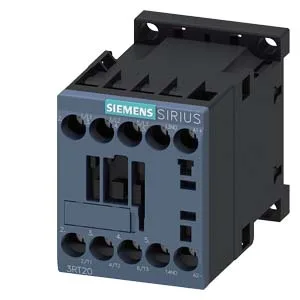
The contactor mounts via screw fixing or snap-on onto a standard 35 mm DIN rail per DIN EN 60715, and the mounting position allows +/-180° rotation on a vertical surface plus +/-22.5° tilt forward/backward — useful when panel space forces an unconventional orientation.
The 10 A rating at 24 VDC is the headline figure for DC switching — this is the current the main contacts can make and break at that voltage. For higher DC voltages, the rating drops: 2 A at 48 V and 60 V, 1 A at 110 V, 0.9 A at 125 V, and 0.3 A at 220 V. That derating curve is typical for DC loads where arc extinction is harder, so if your circuit runs at 48 V, you're limited to 2 A per contactor. The coil is screw-type terminals, accepting solid or stranded wire from 0.5 to 4 mm², or two conductors in parallel (2x 0.5–1.5 mm², 2x 0.75–2.5 mm², or 2x 4 mm²). That's standard for a size S00 contactor and matches typical control wiring in a panel.
The contactor is rated for switching frequencies up to 1000 operations per hour at AC-1 (resistive loads), 750/h at AC-2 and AC-3 (motor starting/running), and 250/h at AC-4 (plugging/inching).