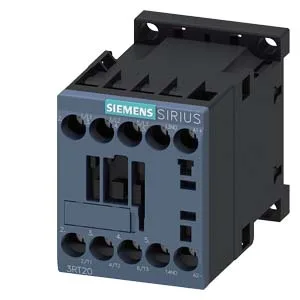
The coil pulls in at 0.8 x rated voltage and drops out around 1.1 x rated voltage, so it holds cleanly on a nominal 24 V bus. Mechanical life is typical 30 million operations, which is standard for this frame size.
That's tight enough for a crowded panel, but watch the 6 mm side gap if you're running multiple contactors side-by-side. Wire range is 0.5 to 4 mm² solid or stranded, and it accepts two conductors per terminal (2x 0.5-1.5 mm², 2x 0.75-2.5 mm², or 2x 4 mm²).
Switching times: DC coil operates in 7-13 ms; arcing time is 10-15 ms. Maximum operating frequency depends on duty: 1,000 ops/h for AC-1 (resistive), 750 ops/h for AC-3 (motor starting) and AC-3e, 750 ops/h for AC-2, and 250 ops/h for AC-4 (plugging/inching). That AC-4 limit matters if you're doing frequent reversing or jogging — the contactor is rated for it but at a quarter the rate of straight motor starting. Auxiliary contact ratings span 10 A at 24 V down to 0.3 A at 220 V, with a 2 hp rating at 230 V.