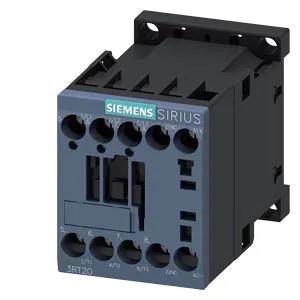
That means it fits into tight panel layouts where orientation isn't fixed. The coil draws its rated value at 24 V DC, and the main contacts are rated 10 A at that same 24 V. That 10 A figure is the switching capacity at the coil voltage — so if you're switching a 24 V DC load, that's your current ceiling. The contactor also carries an auxiliary switch, which saves adding a separate block for status feedback. Mechanical life is typical 30,000,000 operations. Electrical life depends on duty: at AC-3 (motor switching) it's rated 750 operations per hour maximum; at AC-4 (inching/plugging) it drops to 250 1/h. That's the difference between a conveyor starter and a reversing duty cycle — pick the right rating for your load profile.
Dimensions: 45 mm wide, 58 mm high, 73 mm deep. That's a compact footprint for a contactor with an auxiliary switch built in. That's the minimum air gap for heat dissipation and arc containment — don't crowd it against the gland plate. Terminals accept solid or stranded wire: 0.5 to 4 mm² single, or 2x (0.5 to 1.5 mm²), 2x (0.75 to 2.5 mm²), or 2x 4 mm². That covers most panel wiring up to 12 AWG. The screw-type terminals are standard — no special tooling needed.
The storage limit is wider because the contactor isn't switching under those extremes — just sitting on a shelf.