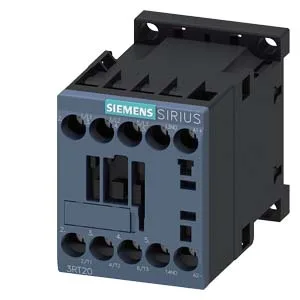
The S00 size keeps the panel footprint compact at 45 mm wide, 58 mm tall, and 73 mm deep. The coil is rated 230 V AC, with an operating range of 0.8 to 1.1 times the rated value, so it picks up reliably down to about 184 V and drops out cleanly. Coil termination is screw-type, matching the main contact wiring style.
The contactor is rated for 2 hp at 230 V, which is the motor load it can handle on a single-phase 230 V line. For DC switching, it's rated 10 A at 24 V, 2 A at 48 V and 60 V, 1 A at 110 V, 0.9 A at 125 V, 0.3 A at 220 V, and 3 A at 400 V — these are the maximum currents it can interrupt in DC circuits at those voltages, so match your DC load voltage to the correct row. Switching frequency limits vary by duty class: 1,000 cycles per hour for AC-1 (resistive), 750 for AC-2 and AC-3 (motor starting/running), and 250 for AC-4 (plugging/inching). The AC-3e rating also caps at 750 cycles per hour. If your application cycles faster than these limits, the contactor will overheat — these are not suggestions. Electrical life depends on the load and switching frequency.
Wiring and Clearance
Main contact terminals accept solid or stranded wire from 0.5 to 4 mm², with multiple conductor configurations: 2x (0.5 to 1.5 mm²), 2x (0.75 to 2.5 mm²), or 2x 4 mm². This covers most control panel wiring sizes. These are minimums — crowding the contactor reduces heat dissipation and shortens life. Factor these into your timing coordination if the contactor is in a safety circuit or sequential start. An auxiliary switch is included, which saves adding a separate block for basic status feedback.
When sourcing, confirm the coil voltage (230 V AC) and the S00 frame size match your BOM. The screw-type terminals are the standard termination; if your panel uses spring-cage, you'd need a different suffix.