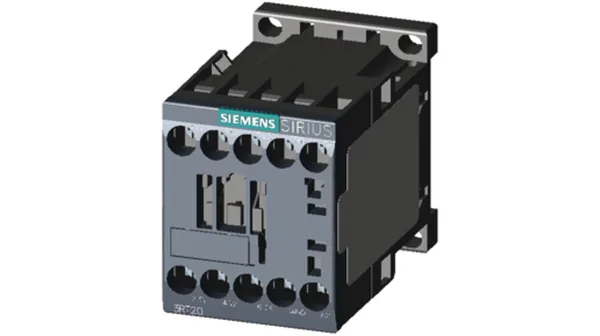
The 24 VDC coil (screw-type terminals) pulls in reliably across the rated control voltage, and the main contact range of 20 to 12 A covers small motors, pumps, and conveyor drives up to the AC-3 duty class.
Duty-cycle and switching-frequency limits
Maximum switching frequency depends on the load type: 1,000 operations per hour at AC-1 (resistive), 750/h at AC-2 and AC-3 (motor start/run), and 250/h at AC-4 (plugging/inching). The AC-3e rating also caps at 750/h. These numbers set the practical cycle limit for a given application — exceeding them accelerates contact wear, especially on inductive loads where arcing time runs 10 to 15 ms.
Auxiliary contact ratings across voltages
The built-in auxiliary switch handles control-circuit signaling at various DC voltage levels: 10 A at 24 V, 2 A at 48 V or 60 V, 1 A at 110 V, 0.9 A at 125 V, 0.3 A at 220 V, and 3 A at 400 V. For AC motor loads, the 230 V rating is given as 2 hp. These values define the signal-switching capability for PLC inputs, indicator lamps, or interlock circuits — derate if the auxiliary contacts drive solenoids or small contactor coils directly.
Wiring and conductor sizes
For double conductors, the range is 2x (0.5 to 1.5 mm²), 2x (0.75 to 2.5 mm²), or 2x 4 mm². The 58 mm height and 45 mm width leave room for finger-safe wiring without cramping — standard for a Size S00 contactor on a DIN rail.