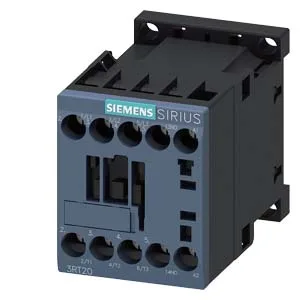
Terminal capacity accepts solid or stranded from 0.5 to 4 mm², and up to 2x 4 mm² or 2x (0.75 to 2.5 mm²) for paralleled conductors. No auxiliary switch is built in, so if you need a feedback signal, plan for a separate auxiliary contact block on the front.
Switching performance and life
Mechanical service life is typical 30 million operations — that's a lot of cycles for a coupling contactor. Switching frequency depends on duty: up to 1000 cycles/hour for AC-1 resistive loads, 750 for AC-2 and AC-3 motor starting, and 250 for AC-4 plugging/reversing. AC-3e matches the AC-3 rate. Arcing time runs 10 to 15 ms, which is normal for a DC coil contactor of this size.
DC switching capability across voltages
Rated current drops as DC voltage rises: 10 A at 24 V, 2 A at 48 V and 60 V, 1 A at 110 V, 0.9 A at 125 V, 0.3 A at 220 V, and 3 A at 400 V. The 400 V rating is notable — it can switch a 3 A DC load at that voltage, which covers some battery bank or solar string isolation applications. The 230 V AC motor rating is 2 hp, so it's also usable for small single-phase motors.