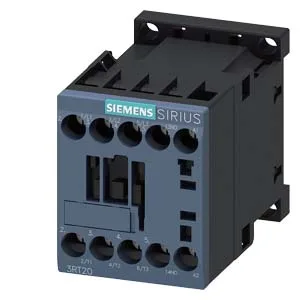
The Siemens 3RT2017-1WB41 is a SIRIUS coupling contactor in the size S00 frame — the smallest footprint in the SIRIUS family, designed for switching auxiliary and control circuits rather than main motor loads. It snaps onto a 35 mm DIN rail per DIN EN 60715 and can be mounted in any orientation, including rotated ±180° on a vertical surface or tilted ±22.5° forward/backward. This is a dedicated coupling contactor: it has no built-in auxiliary switch block, so any feedback or status signaling requires an add-on auxiliary contact block (sold separately). The coil is screw-type terminals rated for 24 VDC with a pickup threshold of 0.85 × nominal (20.4 V) and a dropout of 1.85 × nominal (44.4 V) — meaning it holds in solidly once pulled in but drops out cleanly if the supply sags.
Switching Capacity — What the Ratings Mean
The DC switching table tells the real story for a coupling contactor: 10 A at 24 VDC, 2 A at 48 V and 60 VDC, tapering to 0.3 A at 220 VDC. These are the currents it can break in a DC circuit without welding the contacts — the arc extinction is magnetic, so the lower the voltage, the higher the current it handles. For AC motor control, it's rated 2 hp at 230 V single-phase, which covers small pumps, fans, or conveyor drives up to about 1.5 kW. Switching frequency limits vary by duty class: 1,000 cycles/hour for AC-1 resistive loads, 750 cycles/hour for AC-2 and AC-3 motor starting, and 250 cycles/hour for AC-4 plugging/reversing.
Clearance distances are tight: 10 mm above and below, 10 mm forward, 6 mm to the side. That means it fits in crowded enclosures but you need to respect those gaps for arc flash and heat dissipation. Terminals accept solid or stranded wire from 0.5 to 4 mm², or two conductors of smaller gauges (2× 0.5–1.5 mm², 2× 0.75–2.5 mm², or 2× 4 mm²). Screw-type terminals mean you need a screwdriver for termination — no spring-cage speed, but reliable for high-vibration environments.