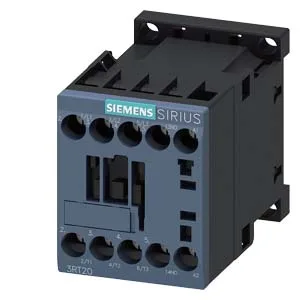
It carries a 72-125 V DC coil with screw-type terminals, and its main contacts are rated for 20-12 A depending on the duty class. The 45 mm width and 58 mm height let it snap onto a 35 mm DIN rail per DIN EN 50022, with 10 mm clearance needed above and below for arc dissipation.
Coil voltage and switching performance
The DC coil picks up at 70% of rated voltage (about 50 V on a 72 V nominal supply) and drops out at 125% of rated, so it holds in during brownouts down to roughly 50 V and releases cleanly when the control voltage rises above 90 V. Inrush current peaks at 1.1 A, and the operate time runs 25-45 ms with an arcing time of 10-15 ms. That arcing window matters for coordination with upstream fuses or breakers — the contactor clears the arc fast enough to avoid nuisance trips on a typical motor branch circuit.
Contact ratings across voltages
On DC loads, the contactor switches 10 A at 24 V, 2 A at 48 V or 60 V, 1 A at 110 V, 0.9 A at 125 V, and 0.3 A at 220 V. For AC motor duty at 230 V it handles 2 hp, and at 480 V it switches 11 A. The AC-4 maximum switching rate is 250 operations per hour, which covers frequent jogging or inching applications.
Screw terminals accept solid or stranded wire: 2x 0.5-1.5 mm², 2x 0.75-2.5 mm², or 2x 4 mm². Side clearance is only 6 mm, so you can pack multiple units tight in a row.