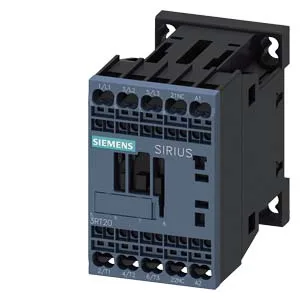
The Siemens SIRIUS 3RT2017-2AP02-ZX95 is a Size S00 power contactor built for switching motor loads in control panels. It mounts via screw and snap-on onto 35 mm DIN rail per DIN EN 60715, making it a direct fit into standard enclosure layouts. The spring-type terminals on the magnet coil accept solid or stranded conductors from 0.5 to 4 mm², so the wireman can land power and control wiring without retightening screws.
What the ratings mean for fit
At 45 mm wide and 73 mm deep, this contactor occupies a single 45 mm slot on the DIN rail — same footprint as the rest of the S00 family. That depth (73 mm) clears most standard 200 mm deep enclosures with room for wiring ducts behind it. The 70 mm height keeps it below typical busbar or trunking runs mounted at 150 mm pitch. The mounting position allows +/-180° rotation on a vertical surface and +/-22.5° tilt forward/backward. That flexibility matters when the panel layout forces a non-vertical orientation — you can still fit it without derating, as long as the ambient stays within -25 to +60 °C during operation. Clearance distances are specified: 10 mm upwards, 10 mm forwards, 10 mm downwards, and 6 mm at the side. These are the minimum air gaps to adjacent metalwork or other devices. A panel builder stacking contactors side-by-side on the rail needs to leave that 6 mm side gap for arc containment and heat dissipation.
Switching duty and lifecycle
The contactor is rated for different switching frequencies depending on the load category: up to 1,000 operations per hour for AC-1 resistive loads, 750 ops/h for AC-2 and AC-3 motor starting, and 250 ops/h for AC-4 plugging or inching duty. The AC-3e maximum matches the AC-3 figure at 750 ops/h. The typical mechanical life of the contactor is 30 million operations, which covers years of cycling in a conveyor or pump application. The auxiliary switch is built in — no separate add-on block required for basic status feedback. The arcing time on the main contacts runs 10 to 15 ms at AC, with a spread of 4 to 15 ms depending on the point in the current waveform where the contacts part.
