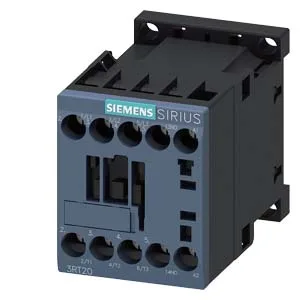
The Siemens 3RT2017-2KB42-1AA0 is a SIRIUS coupling contactor in frame size S00, designed for switching DC loads in control circuits. At 45 mm wide, 70 mm tall, and 73 mm deep, it occupies a single 45 mm module slot — standard for the S00 frame.
Switching ratings and duty cycle
The DC switching capacity is the headline here: 10 A at 24 V, derating to 2 A at 48/60 V, 1 A at 110 V, 0.9 A at 125 V, and 0.3 A at 220 V. That 10 A at 24 VDC is the figure that governs most control-circuit applications — it comfortably handles a bank of solenoid valves or indicator lamps without an interposing relay. Electrical life depends on load: at AC-1 (resistive) the contactor manages 1,000 operations per hour; at AC-3 (motor starting) and AC-2 it drops to 750 per hour; at AC-4 (plugging/inching) to 250 per hour. For DC switching, the 10 A at 24 V rating is the practical limit — stay within the resistive load curve for full life.
Environmental and installation constraints
The contactor has no auxiliary switch built in (auxiliary switch: No), so if you need feedback or status signaling, plan for a separate auxiliary contact block or a different variant. Clearances: 10 mm upwards, downwards, and forwards; 6 mm at the sides — standard for S00 frame spacing on a DIN rail.