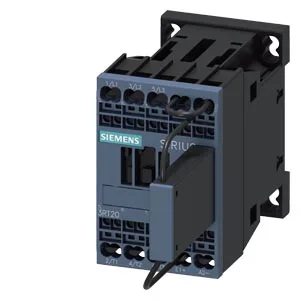
It's built for the usual panel-mount job: switching motor loads, resistive heaters, or other three-phase gear inside an enclosure. The 45 mm width and 121 mm depth mean it slots into a standard DIN-rail footprint without crowding adjacent devices — you can gang several of these across a 35 mm rail and still have room for a terminal block row below.
The coil pulls 72 V DC, which is a common control voltage in industrial DC buses. The spring-type terminals on the coil save you a screwdriver turn per wire — strip, push, done. Rated operational current hits 10 A at 24 V DC, 11 A at 480 V, and 11 A at 600 V. That 11 A at 480/600 V is the number to size your motor branch circuit against if you're switching a 3-phase load at those voltages.
Mounting and environment — panel integration notes
That helps when you're squeezing it into a tight gland-plate layout. Clearances: 10 mm upwards and forwards, 6 mm at the sides. If your panel sees freeze-thaw cycles in an unheated warehouse, this contactor handles it.
Wiring — what the terminal specs actually tell you
The main contact terminals accept solid conductors: 2x (0.5 to 1.5 mm²), 2x (0.75 to 2.5 mm²), or 2x 4 mm². That covers most panel wiring from signal-level runs up to 4 mm² for motor feeds. The coil terminals are spring-type, so you'll want a ferrule on stranded wire to keep strands from splaying under the spring cage. Strip length is standard for spring terminals — about 8-10 mm — but the datasheet will confirm.