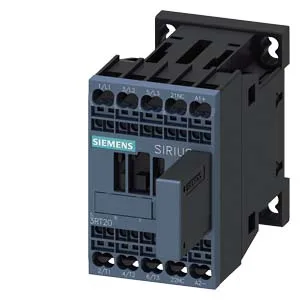
SIRIUS Coupling Contactor for 24 V DC Control Circuits
The 3RT2017-2QB42: The 45 mm width and 121 mm depth fit the standard S00 DIN-rail footprint, and the screw and snap-on mounting onto 35 mm DIN rail per DIN EN 60715 allows rapid panel integration without additional hardware.
Switching Capability and Duty Cycles
Rated for 10 A at 24 V DC, with a maximum switching frequency of 1 000 operations per hour under AC-1 resistive load, and 750 ops/h under AC-3 motor duty. This makes it suitable for moderate-speed coupling applications such as signaling between control systems or pilot-duty switching. The mechanical life of 30 000 000 operations typical indicates a long service interval in lightly loaded or dry-circuit applications, though contact wear under rated load will reduce electrical life proportionally.
Wiring and Mounting Flexibility
Spring-type terminals accept solid or stranded conductors from 0.5 to 4 mm², including two conductors per clamp (2x 0.5 to 4 mm²), which simplifies daisy-chaining or paralleling control wiring without separate terminal blocks. These are the minimum air gaps to maintain rated insulation; crowding against other components or enclosure walls below these figures may require derating.
As a standard SIRIUS catalog item, the 3RT2017-2QB42 is specified into the BOM with confidence that supply is through normal Siemens distribution channels. No official successor exists because none is needed.