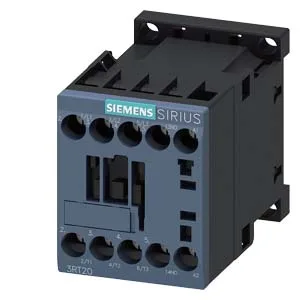
What the 72-125 VDC coil rating means for your control circuit
The 3RT2017-2XF42-0LA2: The 72-125 VDC coil on this SIRIUS S00 contactor means the pickup voltage must be at least 0.7× the rated value (about 50 VDC minimum), and the dropout happens at 1.25× the rated value (about 90 VDC). That dropout margin is generous — the contactor stays pulled in through supply dips that would drop a standard 24 VDC coil. Inrush current peaks at 1.1 A, so the DC supply feeding the coil needs to handle that surge without voltage sag. The holding current is lower, but the 1.1 A peak is what the PLC output or relay driving it has to source for the first few milliseconds.
Panel fit and DIN-rail footprint
At 45 mm wide, 70 mm tall, and 73 mm deep, this S00 contactor takes up one standard DIN-rail module position. Clearance requirements: 10 mm above and below the contactor, 10 mm forward, and 6 mm to the sides. These are the minimum air gaps for heat dissipation and arc quenching — pack them tighter and you derate the thermal capacity. No derating needed for odd angles.
Wire termination and conductor sizing
Spring-type terminals on the coil and main contacts mean no screwdriver torqueing — strip the wire, push it in, done.
Motor load capability and switching duty
At 400 V, this contactor switches 3 A — that's about a 1.5 kW motor at 400 V three-phase. At 480 V it handles 11 A, good for about 7.5 hp. At 230 V it's rated 2 hp. These are the AC-3 motor switching ratings — the values that matter for sizing the contactor to the motor full-load current. These are resistive load ratings — inductive DC loads need further derating. AC-4 duty (plugging or inching) is limited to 250 operations per hour maximum. For normal AC-3 motor starting, the mechanical life of 30 million operations means this contactor will outlast the panel it's mounted in.
Environmental limits and storage
That covers most industrial enclosures, including unheated warehouses in cold climates. The arcing time of 10-15 ms and DC dropout time of 25-45 ms are timing specs that matter for coordination with upstream motor circuit protectors.