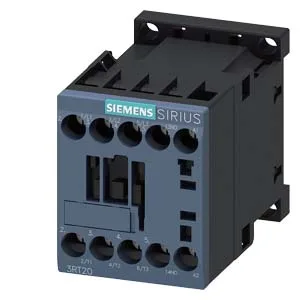
Its 24 VDC coil with a ring cable lug connection is a common control voltage for PLC-driven systems, and the contactor carries a 24 V rated operational current of 10 A, which governs its use for DC load switching at that voltage level. The contactor mounts via screw or snap-on onto a 35 mm DIN rail per DIN EN 60715, and the mounting position allows +/-180° rotation on a vertical surface plus +/-22.5° tilt forward and backward, giving panel builders flexibility in tight enclosures.
The 10 A rating at 24 V is the headline DC-1 switching current for this contactor — it tells you the maximum resistive load current it can make and break at that voltage. For inductive DC loads (DC-3, DC-5), the ratings drop significantly: 2 A at 48 V and 60 V, 1 A at 110 V, 0.9 A at 125 V, and 0.3 A at 230 V. These are the numbers that matter when you are switching solenoids, brakes, or DC motor fields — the 10 A figure is not a blanket rating. For AC motor duty (AC-3), the contactor is rated for 750 operating cycles per hour maximum, and for AC-1 resistive loads it can handle up to 1,000 cycles per hour. The coil connection uses a ring cable lug, so verify your wiring terminations match that format before panel assembly.