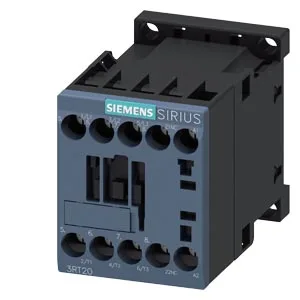
The 10 A rating at 24 VDC is the headline figure for this Size S00 frame. This is the contactor's rated operational current for DC-1 (resistive) loads at that voltage — meaning it can switch a 24 VDC resistive circuit up to 10 A continuously. For DC motor or inductive loads, the switching capacity derates significantly: 2 A at 48 V, 0.3 A at 220 V, and 0.2 A at 440 V, so verify the load type and voltage against these curves before specifying. Switching frequency limits are given per duty class: up to 1,000 operations per hour for AC-1 (resistive), 750/h for AC-2 and AC-3 (motor starting), and 250/h for AC-4 (plugging/inching). These are mechanical endurance limits for the contactor's design; exceeding them accelerates wear on the main contacts. The contactor accepts solid or stranded conductors from 0.5 to 4 mm², with dual-wire capability for 2x 0.5...1.5 mm² or 2x 0.75...2.5 mm². This covers most panel wiring sizes for control circuits and smaller motor loads.
The Size S00 footprint — 45 mm wide, 58 mm high, 73 mm deep — fits standard 45 mm modular spacing, leaving room for auxiliary contact blocks alongside.