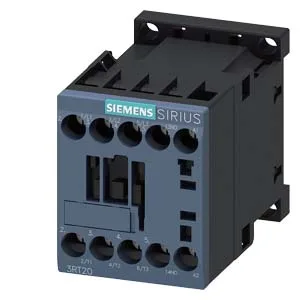
It carries a 2 hp rating at 230 V, making it a fit for small motors on pumps, fans, and conveyors. The S00 frame keeps the footprint tight at 45 mm wide, 58 mm tall, and 73 mm deep — it slides onto a 35 mm DIN rail per DIN EN 60715 with either screw or snap-on mounting. That's a standard panel integration; no special brackets needed.
The contactor's switching frequency depends on the duty class. For AC-3 motor starting, it handles up to 750 operations per hour; for AC-4 inching or plugging, that drops to 250 per hour. That means if you're running a conveyor that cycles every few seconds, stay within the AC-3 limit. The auxiliary contact ratings are given at several voltages: 10 A at 24 V, 2 A at 48 V and 60 V, 1 A at 110 V, 0.9 A at 125 V, 0.3 A at 220 V, and 0.2 A at 440 V. These are the switching limits for the built-in auxiliary switch — use them to size your PLC input or relay coil draw. At 400 V the auxiliary is rated 3 A, which covers most contactor feedback circuits. Wire termination uses screw-type terminals on the coil and main contacts. The terminals accept solid or stranded wire from 0.5 to 4 mm², and you can double up two conductors per clamp (2x 0.5-1.5 mm², 2x 0.75-2.5 mm², or 2x 4 mm²). That helps when you need to daisy-chain control power without adding a terminal block.
Mounting position is flexible — the contactor can be hung on a horizontal surface or mounted vertically. These are the minimum air gaps to maintain for heat dissipation and arc quenching; don't cram it tighter in a dense panel.