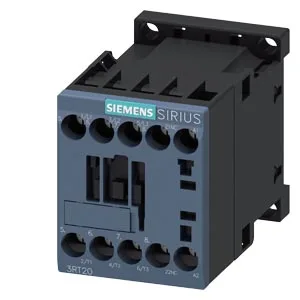
Panel fit and switching duty
Switching frequency varies by duty class: up to 1 000 cycles/hour for AC-1 resistive loads, 750 cycles/hour for AC-2 and AC-3 motor starting, and 250 cycles/hour for AC-4 plugging/reversing. That means this contactor handles high-rate conveyor cycling in AC-3, but you'll want to derate for frequent inching or reversing applications. The arcing time sits at 10...15 ms, and the opening time (at AC) is 4...15 ms — fast enough for most control schemes. A built-in auxiliary switch (20...12 range for main contacts) eliminates the need for a separate add-on block in many simple circuits. Coil termination uses screw-type terminals; the main circuit accepts solid or stranded wire from 0.5 to 4 mm², with options for dual conductors (2x 0.5...1.5 mm², 2x 0.75...2.5 mm², or 2x 4 mm²).
Mounting flexibility and clearances
These are the numbers to check when packing multiple contactors on a DIN rail; the 6 mm side clearance is tighter than many competitors, so plan your terminal block spacing accordingly.