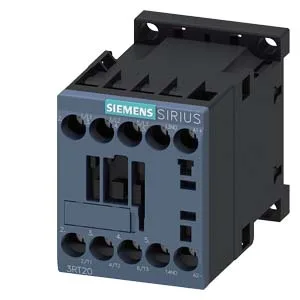
SIRIUS S00 power contactor with 24 V DC coil
The Siemens SIRIUS 3RT2018-1BE41 is a size S00 power contactor from the SIRIUS family, built for switching loads in control panels and machinery. It carries a 24 V DC coil and screw-type terminals for the main and auxiliary contacts. Rated for 10 A at 24 V DC and 3 A at 400 V AC, this contactor handles motor starting, resistive heating, and general switching duties within its rated operational current envelope.
Mounting and integration
Fastens via screw or snap-on onto 35 mm standard mounting rail per DIN EN 60715, occupying a 45 mm width footprint. The S00 frame keeps panel density high — typical for sub-distribution or machine-cabinet layouts where space is tight. Mounting position is flexible: ±180° rotation on a vertical surface, plus ±22.5° tilt forward/backward. Clearance requirements: 10 mm upwards, 10 mm forwards, 10 mm downwards, and 6 mm at the side — useful when fitting into a crowded gland plate or alongside other contactors. Operating temperature range of -25 to +60 °C, storage from -55 to +80 °C, so it suits both conditioned control rooms and warmer cabinet interiors near motors or drives.
Switching performance and contact ratings
DC switching capacity is specified at several voltages: 10 A at 24 V, 2 A at 48 V, 2 A at 60 V, 1 A at 110 V, 0.9 A at 125 V, 0.3 A at 220 V. That 10 A at 24 V DC is the headline figure for DC load switching — think solenoid valves, DC relays, or small DC motor brakes. At 400 V AC the contactor is rated 3 A, and at 230 V it carries a 2 hp motor load. Mechanical endurance is typical for the class at 30 million operating cycles. Switching frequency limits: 1000 cycles/h at AC-1 (resistive), 750 cycles/h at AC-3 (motor starting), and 250 cycles/h at AC-4 (plugging/inching). The AC-3e rating matches the AC-3 figure at 750 cycles/h. These matter for high-duty applications like conveyor indexing or frequent start-stop cycles. Arcing time is 10 to 15 ms, and the DC operate time is 7 to 13 ms — both within expected ranges for a contactor of this size, giving predictable switching behaviour for timing-dependent circuits.
Wiring and auxiliary contacts
Screw terminals accept solid or stranded wire: 0.5 to 4 mm² single, or 2x (0.5 to 1.5 mm²), 2x (0.75 to 2.5 mm²), and 2x 4 mm². The auxiliary switch is built in, eliminating the need for a separate add-on block for basic signalling. Main contact configuration: 20... 12.
