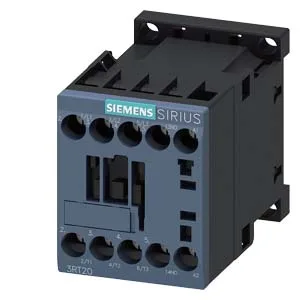
It snaps onto 35 mm DIN rail per DIN EN 60715 or screws directly to a mounting plate, occupying a 45 mm width slot. The 73 mm depth keeps it clear of deeper busbars or terminal blocks in a typical 200 mm deep enclosure. Screw-type terminals on the magnet coil and main contacts accept solid or stranded wire from 0.5 mm² up to 4 mm², with dual-wire capability for looping through control wiring without an extra junction block.
What the switching rates tell you
The contactor is rated for 1 000 operations per hour in AC-1 duty (resistive loads like heaters), 750 per hour in AC-3 (squirrel-cage motor starting), and 250 per hour in AC-4 (plugging or inching). The AC-3 rate is the one that matters for most conveyor, pump, and fan applications — it means the contactor can start a motor every 4.8 seconds continuously without exceeding thermal limits. AC-4 at 250/h reflects the higher arc energy during reversing or jogging cycles. Mechanical life is rated at 3 000 000 operations typical — the contactor itself will outlast the driven equipment in most panel designs. The arcing time sits between 10 and 15 ms at AC, which is consistent with a standard contactor design; no forced arc-chute extinction needed.
The contactor can be mounted in any orientation: +/-180° rotation on a vertical surface, and tilted forward or backward by +/-22.5°. Clearance requirements are 10 mm upwards, 10 mm forwards, 10 mm downwards, and 6 mm at the sides — tight enough for a dense DIN rail array. Operating temperature range is -25 to +70 °C, storage from -55 to +80 °C, so it handles unheated warehouses and panel heat rise without derating.