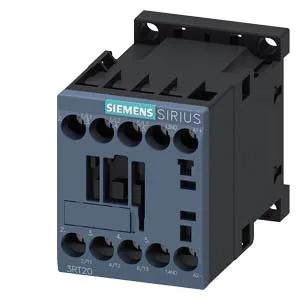
It switches motor loads up to 2 hp at 230 V and carries 14 A at 480 V — the AC-3 motor rating governs the real-world duty, not the resistive curve. The coil draws a 1.1 A inrush peak and holds at 0.7 times the rated voltage, dropping out at 1.25 times the rated value. That wide dropout margin means it stays closed through brief sags common on DC control buses fed by unregulated rectifiers. Size S00 is the smallest SIRIUS frame — 45 mm wide, 58 mm tall, 73 mm deep — and mounts via screw or snap-on onto a 35 mm DIN rail per EN 50022. That compact footprint and generous position tolerance make it a candidate for dense panels where every millimeter of DIN rail is allocated.
The contactor is rated for DC switching across the coil voltage range: 10 A at 24 V DC, 2 A at 48 V and 60 V, 1 A at 110 V, 0.9 A at 125 V, 0.3 A at 220 V. On the AC side, it delivers 3 A at 400 V, 14 A at 480 V, 2 A at 500 V, and 11 A at 600 V. The 2 hp rating at 230 V is the motor-starting figure — the AC-4 maximum switching rate of 250 operations per hour sets the ceiling for plugging or inching duty. Arcing time runs 10-15 ms, and the DC switching time is 25-45 ms. For a sourcing decision, the 14 A at 480 V and 2 hp at 230 V are the load-bearing numbers for typical three-phase motor circuits. The auxiliary switch is integrated (yes), and the main contact rating is listed as 20-12. Mechanical life is typical 30,000,000 operations. These numbers confirm the contactor is rated for industrial enclosures without forced cooling, even in cold environments like unheated warehouses.
Wiring and terminal details
The coil terminals are screw-type. The main and auxiliary terminals accept solid or stranded conductors: 2x (0.5-1.5 mm²), 2x (0.75-2.5 mm²), or 2x 4 mm². That covers most control-circuit wiring up to 4 mm² — typical for motor starters up to 2 hp. The screw terminals are field-friendly for panel builders who prefer traditional termination over spring-cage.