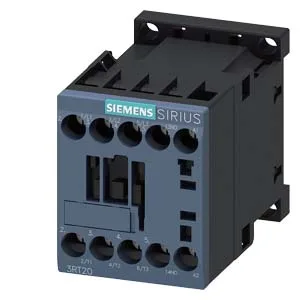
The 24 VDC coil pulls in at nominal voltage and holds reliably across the -25 to +60 °C operating range. Coil terminals are spring-type (push-in), which speeds wiring compared to screw terminals — strip 8 mm, push, done.
Size S00 means the contactor body is 70 mm tall, 45 mm wide, and 73 mm deep — compact enough to pack several units side-by-side on a DIN rail. The 45 mm width is a single modular unit (1 MW = 18 mm), so it occupies 2.5 MW of rail space. That matters when you're laying out a dense panel and every millimeter of DIN rail is spoken for. Switching frequency varies by duty class: up to 1,000 cycles/hour for AC-1 resistive loads, 750 cycles/hour for AC-2 and AC-3 motor loads, and 250 cycles/hour for AC-4 (plugging/inching). If your application cycles a motor on/off every few seconds, the AC-3 ceiling of 750 ops/hour (one cycle every 4.8 seconds) is the hard limit — exceed it and the contactor overheats. The auxiliary switch is built in (1 NO + 1 NC, 20...12 on the main contact scale), which saves buying a separate side-mount block for basic feedback. For higher auxiliary contact counts, you add a SIRIUS auxiliary switch block that clips onto the front.
That means it fits in panels where the DIN rail is mounted sideways or at an angle — common in tight retrofit enclosures.
Wire range: solid or stranded 0.5...4 mm², with two conductors per terminal possible (2x 0.5...4 mm²). The spring terminals accept ferruled stranded wire cleanly. That 6 mm side gap is tight — if you're mounting contactors side-by-side, they can touch; the gap is for air circulation, not electrical clearance.