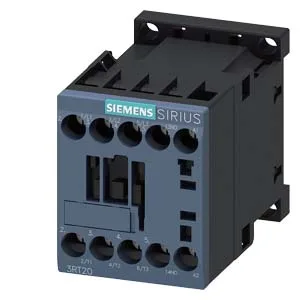
The coil is 24 VDC, terminated with spring-type terminals, and the main contacts are rated for 20 to 12 A depending on the duty cycle.
The AC-3 switching current is 6 A at 24 V, which governs motor switching under typical induction motor start conditions — that's the rating that matters for sizing it to a small conveyor or pump motor on a 24 V control circuit. At higher voltages, the switching capacity drops: 2 A at 48 V and 60 V, 1 A at 110 V, 0.9 A at 125 V, 0.3 A at 220 V, and 0.2 A at 440 V — so it's primarily a low-voltage machine-tool contactor, not a 400 V motor starter. At 230 V it carries a 2 hp motor rating, which is the standard NEMA sizing for a small single-phase motor. The mechanical life is 10 million operations typical, and the maximum switching rate is 1000 cycles/hour in AC-1 (resistive), 750 in AC-2 and AC-3 (motor), and 250 in AC-4 (plugging/inching) — the AC-4 limit is the one to watch if the application does frequent reversing or jogging.
Wiring and Integration Details
The spring-type terminals accept solid or stranded wire from 0.5 to 4 mm², and 2x (0.5 to 4 mm²) for paralleled conductors — common for daisy-chaining control wiring in a panel. Operating temperature is -25 to +60 °C, storage -55 to +80 °C — fine for most indoor panel environments, but check if the panel ambient near a hot drive exceeds 60 °C.
It's a standard fast-mover in the SIRIUS line — the size S00 frame is widely stocked because it covers the most common small motor and resistive loads in machine tool and conveyor panels.