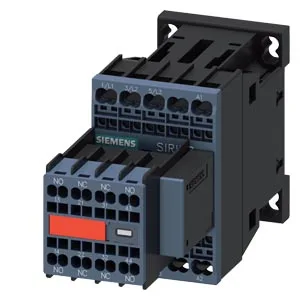
SIRIUS S00 Power Contactor with Spring-Terminal Coil Connection
Its defining feature for this order code is the spring-type terminal on the magnet coil, which eliminates the need for screwdriver torque verification on the coil connection — a time-saver during panel wiring and a reliability point in high-vibration environments.
Switching Frequency and Duty-Cycle Limits
Maximum switching rates are specified per AC duty class: 1,000 operations per hour at AC-1 (resistive load), 750/h at AC-2 and AC-3 (slip-ring and squirrel-cage motors), and 250/h at AC-4 (plugging/reversing). The AC-3e rating also caps at 750/h. For a conveyor or pump running at 30 starts per hour, these limits are generous; for a rapid-reversing application like a crane hoist, the AC-4 ceiling of 250/h is the binding constraint — exceeding it risks contact welding and reduced mechanical life.
Auxiliary Contact Ratings and Wiring Details
The contactor carries no built-in auxiliary switch block, so any auxiliary contacts must be added as separate side-mounted units. When present, the contact ratings span the control-voltage range: 6 A at 24 V, 2 A at 48 V and 60 V, 1 A at 110 V, 0.9 A at 125 V, 0.3 A at 220 V, and 3 A at 400 V. The 440 V rating drops to 0.2 A. These are the make/break capacities for the auxiliary circuit — useful for sizing PLC inputs or relay coils downstream. Wire sizes accepted: solid or stranded 0.5 to 4 mm², with dual-wire capability up to 2x (0.5 to 4 mm²) per terminal.