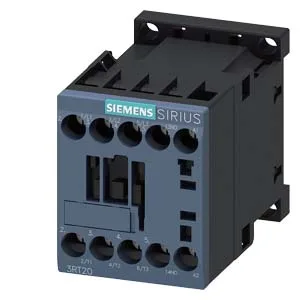
The coil is rated at 100 V at 50 Hz and 110 V at 60 Hz, drawing 0.24 A at 50 Hz and 0.25 A at 60 Hz — a key figure for sizing the control transformer supplying the coil.
The contactor carries rated operational currents at multiple voltage levels: 10 A at 24 V, 2 A at 48 V and 60 V, 1 A at 110 V, 0.9 A at 125 V, 0.3 A at 220 V, 3 A at 400 V, 0.2 A at 440 V, 14 A at 480 V, and 2 A at 500 V. These are the currents the main poles can make and break under specified conditions — the 14 A at 480 V figure, for instance, tells you it handles a 480 V motor load up to that current. At 230 V it is rated for 2 hp, which maps to a typical small pump or fan motor. The switching frequency varies by duty class: up to 1,000 operations per hour at AC-1 (resistive), 750 per hour at AC-2 and AC-3 (motor starting/running), and 250 per hour at AC-4 (plugging/inching). For a conveyor application running AC-3 duty, the 750 ops/h limit governs the cycle rate.
The contactor has a mechanical service life of 30,000,000 operations typical — a figure that assumes proper coil voltage and load within ratings.
Physical dimensions and auxiliary contacts
The width is the critical panel-space figure — at 45 mm, it occupies one standard 45 mm-wide DIN-rail module slot. The magnet coil connection uses a ring cable lug, which means the installer needs to crimp ring terminals onto the control wiring.