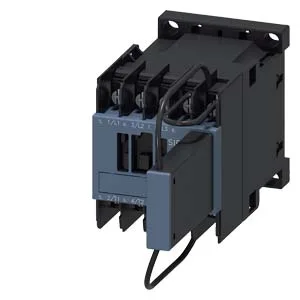
It has an extended operating range with a pickup threshold of 0.7 times rated value. Physically it's compact: 45 mm wide, 61 mm tall, 117 mm deep. That puts it in the standard S00 footprint that fits tightly packed DIN-rail enclosures. Mounting is via screw or snap-on onto 35 mm rail per DIN EN 60715, and side-by-side mounting is allowed with the specified clearances — 10 mm upward, 10 mm forward, 10 mm downward, 6 mm at the side.
What the DC switching ratings mean for your load
This contactor carries a full set of DC-1 / DC-13 style switching ratings across the voltage range, and the values tell you exactly what it can break without welding contacts. At 24 V DC it's rated 10 A — that's the sweet spot for most control and small DC motor loads. At 48 V and 60 V it drops to 2 A, at 110 V to 1 A, at 220 V to 0.3 A, and at 690 V to 1 A. The 480 V and 600 V entries (14 A and 11 A respectively) look like AC ratings — likely AC-3 motor duty — so don't confuse those with DC interrupt capability at those voltages. That's fast enough for most interlocking and sequencing circuits, but if you're paralleling contacts for higher DC current, account for the total arcing energy across the gap.
The auxiliary switch is integrated (yes), so there's no separate add-on block to order for basic status feedback.
The coil connection uses a ring cable lug. The main power terminals accept solid conductors: 2x 0.5 to 1.5 mm², 2x 0.75 to 2.5 mm², or 2x 4 mm². That helps when you're fitting it into a crowded panel or a non-standard orientation.